
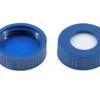
ER01113
9 mm Blue Screw Cap, Blue PTFE / White Silicone Septum, 5.5 mm Hole, 100/pk
9 mm (9-425), PTFE / silicone, 5.5 mm hole, Blue PP cap
In stock in the Czech Republic (EU), ships Fri 20 Nov
€8.60 per pack of 100 €0.086 per cap
Caps and septa for autosampler and headspace vials: 8, 9, 13, 15 and 24 mm screw caps, 11 and 20 mm aluminium crimp caps, 18 mm magnetic screw caps and loose septa, with PTFE/silicone, PTFE/butyl and PTFE-only septa, pre-slit and bonded options.
Caps come in packs of 100. The 9 mm blue screw cap with blue PTFE/white silicone septum is in stock in the Czech Republic (EU) and ships in 1 working day.
9 mm (9-425), PTFE / silicone, 5.5 mm hole, Blue PP cap
In stock in the Czech Republic (EU), ships Fri 20 Nov
Lead time 3-4 weeks, ships from the Czech Republic (EU)
Lead time 3-4 weeks, ships from the Czech Republic (EU)
Lead time 3-4 weeks, ships from the Czech Republic (EU)
Lead time 3-4 weeks, ships from the Czech Republic (EU)
Lead time 3-4 weeks, ships from the Czech Republic (EU)
Lead time 3-4 weeks, ships from the Czech Republic (EU)
Lead time 3-4 weeks, ships from the Czech Republic (EU)
Lead time 3-4 weeks, ships from the Czech Republic (EU)
Lead time 3-4 weeks, ships from the Czech Republic (EU)
Lead time 3-4 weeks, ships from the Czech Republic (EU)
Lead time 3-4 weeks, ships from the Czech Republic (EU)
Lead time 3-4 weeks, ships from the Czech Republic (EU)
Lead time 3-4 weeks, ships from the Czech Republic (EU)
Lead time 3-4 weeks, ships from the Czech Republic (EU)
Lead time 3-4 weeks, ships from the Czech Republic (EU)
Lead time 3-4 weeks, ships from the Czech Republic (EU)
Lead time 3-4 weeks, ships from the Czech Republic (EU)
Lead time 3-4 weeks, ships from the Czech Republic (EU)
Lead time 3-4 weeks, ships from the Czech Republic (EU)
Lead time 3-4 weeks, ships from the Czech Republic (EU)
Lead time 3-4 weeks, ships from the Czech Republic (EU)
Lead time 3-4 weeks, ships from the Czech Republic (EU)
Lead time 3-4 weeks, ships from the Czech Republic (EU)
Lead time 3-4 weeks, ships from the Czech Republic (EU)
13.5 × 1.5 mm
Lead time 3-4 weeks, ships from the Czech Republic (EU)
13.5 × 1.5 mm
Lead time 3-4 weeks, ships from the Czech Republic (EU)
Lead time 3-4 weeks, ships from the Czech Republic (EU)
Lead time 3-4 weeks, ships from the Czech Republic (EU)
On its way to our Czech warehouse
Lead time 3-4 weeks, ships from the Czech Republic (EU)
Lead time 3-4 weeks, ships from the Czech Republic (EU)
Lead time 3-4 weeks, ships from the Czech Republic (EU)
Lead time 3-4 weeks, ships from the Czech Republic (EU)
Lead time 3-4 weeks, ships from the Czech Republic (EU)
Lead time 3-4 weeks, ships from the Czech Republic (EU)
Lead time 3-4 weeks, ships from the Czech Republic (EU)
22 × 3 mm
Lead time 3-4 weeks, ships from the Czech Republic (EU)
22 × 3 mm
Lead time 3-4 weeks, ships from the Czech Republic (EU)
22 × 3 mm
Lead time 3-4 weeks, ships from the Czech Republic (EU)
22 × 3 mm
Lead time 3-4 weeks, ships from the Czech Republic (EU)
22 × 3 mm
Lead time 3-4 weeks, ships from the Czech Republic (EU)
Lead time 3-4 weeks, ships from the Czech Republic (EU)
22 × 3 mm
Lead time 3-4 weeks, ships from the Czech Republic (EU)
22 × 3 mm
Lead time 3-4 weeks, ships from the Czech Republic (EU)
No products match these filters.
The vial decides the cap. Match the neck and closure type first, then choose the septum material and the cap style.
| Vial neck | Typical vials | Cap to order |
|---|---|---|
| 8-425 screw | 2 ml, 11.6 × 32 mm | 8 mm screw cap (ND8) |
| 9 mm short thread | 2 ml and 0.3 ml, 11.6 × 32 mm | 9 mm short-thread screw cap (ND9) |
| 11 mm crimp | 2 ml and 0.3 ml, 11.6 × 32 mm | 11 mm aluminium crimp cap (ND11) |
| 13-425 screw | 4 ml, 14.5 × 45 mm | 13 mm screw cap (ND13) |
| 15-425 screw | 8 ml and 12 ml | 15 mm screw cap (ND15) |
| 18 mm precision screw | 10 ml and 20 ml headspace | 18 mm magnetic screw cap (ND18) |
| 20 mm crimp | 6, 10 and 20 ml headspace | 20 mm crimp cap (ND20) |
| 24-400 screw | 20 to 60 ml EPA vials | 24 mm screw cap (ND24) |
Thread systems are not interchangeable: a 9 mm cap will not seal an 8-425 or 10-425 vial, even though the sizes look close. Crimp caps need a hand crimper, and a decapper to remove them.
| Septum | Use it for | Note |
|---|---|---|
| PTFE/silicone | Most HPLC and GC work, repeat injections | The PTFE face meets the sample; the silicone reseals after the needle is withdrawn |
| PTFE/silicone/PTFE | Samples that may contact both faces of the septum | PTFE on both sides for extra chemical resistance |
| PTFE only | Single injections | Very inert, but does not reseal after piercing |
| PTFE/butyl | Headspace GC and volatile samples | Butyl rubber has low gas permeability; rated for lower temperatures than silicone |
| PE foam liner | Closed caps for storage | Not intended for needle piercing |
Temperature ratings are on each product page. In this range, PTFE/silicone septa are listed for -60 to 200 °C and PTFE/butyl for -60 to 120 °C.
Caps and septa are sold in packs of 100. Order caps with vials: on EROHE, equal packs of 9 mm vials and caps get 5% off both. Not sure which cap fits your vial? Email sales@erohe-lab.com with the vial part number.
Match the neck: 8-425 vials take 8 mm caps, 9 mm short-thread vials take 9 mm caps, 11 mm crimp vials take 11 mm crimp caps, and so on. The guide on this page has a full table.
Caps listed with a septum come assembled. Items listed as septa only, such as the 17.5 mm and 20 mm septa, are loose septa for use in your own caps.
Colour identifies the material layers and helps you tell septa apart; it does not affect performance. Always choose by material, such as PTFE/silicone or PTFE/butyl.
PTFE/silicone septa reseal and can take several injections. PTFE-only septa do not reseal and are for single injections.


